
its strange because several forecasts I have read predict EV sales to outstrip ICE sales within the next five years as they’re growth is exponential, also used sales of EVs under 24 months old are growing due to the fast changing nature of new technology. If the manufacturers you are referring to are your “premium” legacy automakers, then yes, sales are not on target but thats because they are coming up with inferior products and relying on a badge to do their sales, whereas people are starting to chase actual quality instead of perceived quality.

Shaun. I shall ignore your first paragraph as that’s opinion rather than fact, but let’s focus on facts because this is where statistics, especially percentages, can confuse.
You are primarily talking about % growth. It is inevitable that EVs will have by far the greatest % growth, but the issue is that this growth is starting from an incredibly low base. Let’s take some hard facts to illustrate the point (source : Society of Motor Manufacturers & Traders, as reported in Fleet News – link below);
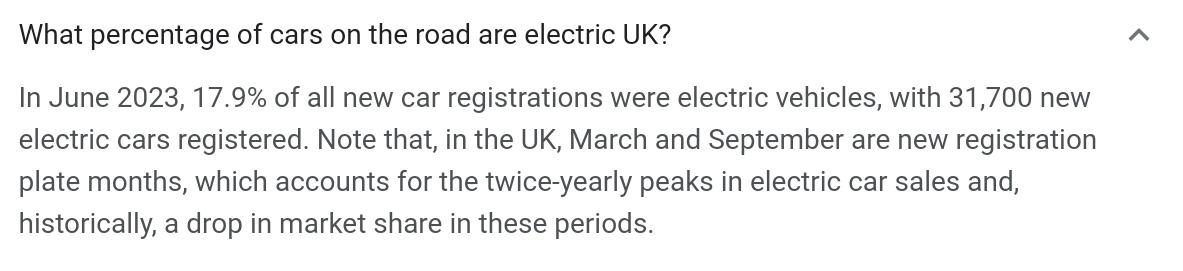
Firstly, yes, EVs in the U.K. have grown by 50% to 1.1m vehicles.
However, there are 35.1m cars on U.K. roads, which means that 34m aren’t EVs.
Put another way, 1 in 32 cars come with a plug, 31 out of 32 don’t.
Even with 50% growth, EVs were only 3.1% of the cars on our roads in 2022, so 96.9% weren’t.
To illustrate further why percentages can confuse;
If the proportion of EVs on our roads grows at 50%, that 3.1% is still only 4.6% a year later. The percentage growth obviously gets more challenging as absolute numbers of EVs grow, hence the prediction of 6% by 2025 and 19% by 2030.
Of course, non-EV cars won’t be increasing by anywhere near these numbers, as there are 31 times more of them to start with. However, even if the number of non-EV cars fell by 10% and EVs grew by 200%, there would still only be 9.3m EVs versus 30.6m non-EVs, so EVs would still only represent 23% of the cars on our roads, less than 1 in 4.
Then you have to factor in that the average car on our roads is 9 years old, something that those of us who have a new car every 3 years can easily forget! This is why the number of ICE cars won’t fall at the rate that some claim, because the vast majority (80%) of new cars being registered, even now, are ICE cars, not EVs and those cars, as well as a large proportion of the 34m ICE cars already in existence will still be on our roads in 2030 and beyond.
Clearly the market is moving towards EVs, that is not in doubt, but because it’s from such a low base it is easy to get carried away by looking at growth rather than absolute numbers. Factor in the actual stats and key things such as how long people keep their cars and it paints a very different picture. And all of that doesn’t even take into account the millions who don’t have an off road home charging solution and the fact that the public charging infrastructure is going backwards, not forwards, in relation to the number of EVs on our roads (1 public charger per 36 EVs, down from 1 for every 31 EVs in 2021)!