
The disadvantage of the Ohme charger is the charge cable and supply cable are installed at the factory in what is essentiallly a sealed box. In particular the supply cable is only 1m in length and virtually useless in the majority of cases, which causes an extra stage installing the charger, which is not as neat/seamless as it could be!
The most likely scenario depending on whether your meter is inside the house or in an outside meter box:
If your meter is inside the home – Most likely the installer will split the outgoing meter tails in whats called a Henley block and install an additional consumer (protected by a 30mA type A RCD and a 32A MCB) inside your meter cupboard if there is space along with an isolation switch if not already present. The installer will then run either 6mm2 twin and earth & data cable cable from the new consumer unit and drill a hole to take the cable outside the property, hopefully with a meter of the charger location. A square junction box will then be mounted on the external wall, where the charger supply cable is also connected. Or, if and trenching work is required 6mm2 armoured (SWA) + data (EVultra cable) will be connected to this juction box and be run to within a meter of the charger where another junction box is needed to be connected to the charger supply cable.
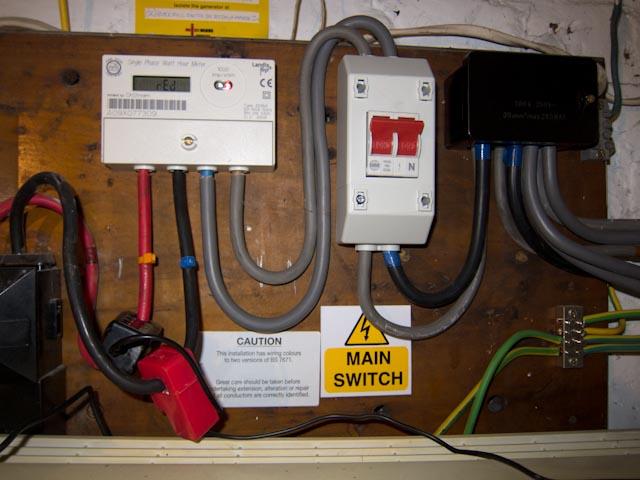
A CT clamp would have been fitted to the incoming live meter tail that connects to the CT terminals in the charger (wireless units are sometimes used) The CT clamp monitors the load in your home and disconnects the charger supply if it detects your are close to blowing your main cutout fuse.
The image shows: Isolator to the right of the meter, to the right of the isolator is a Henley block, that spits the tails for two or more consumer units. Bottom far left shows part of DNO service head and cutout, to the right of that you can see the black CT clamp connected to the live (red) incoming meter tail (next to it is a red CT clamp on the neutral – ignore that for basic EV charger install) In newer homes or those that have had meter swops these cables will be Brown(L) and Blue(N). At the bottom right is a earth clamp that yur likely not to have these days!
If your meter is in a meter box outside your home – The installer will split the outging meter tails using a Henley block and install a new ip65 rated consumer unit (with a 30mA type A RCD and 32A MCB) next to the meter box and then run 6mm2 EV Ultra cable to within a meter of the charger and install a square weatherprrof box, where the charge supply cable is connected. A CT clamp would have also been installed.
As of 22nd September last year Amedment 2 BS7671 18th edition sec 443 requires Installers to ensure SPD’d are fitted. So you will find the installer will fit a DIN mounted surge protection device (SPD) in the consumer unit that supplies the charger,this is to detected voltage surges and ultimately protects you.
As mentioned previous, photo’s/video will be required of your meter cupboard to ensure your equipment and meter tails are up to standard the service head cutout fuse rating (although there likely to check with DNO) and main earth bonding is adequate and in place a the gas meter and incoming water main if required!
This covers the basics 🙂
-
This reply was modified 2 years, 7 months ago by
 kezo.
kezo.
